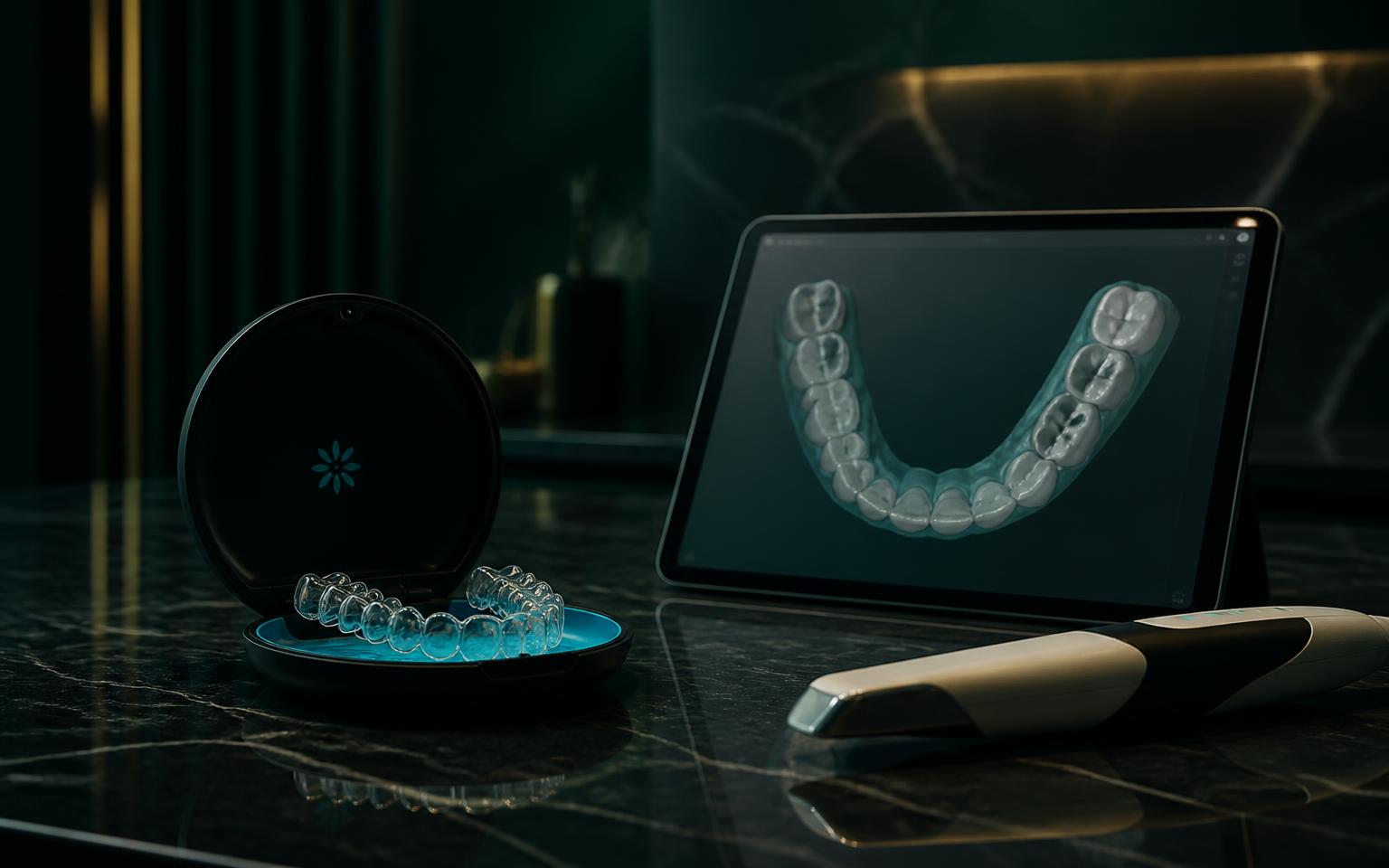
Clear Aligner and Invisalign Advertising for UK Practices
Aligner enquiries are plentiful and easy to waste. The difficulty is not volume — it is suitability, speed of follow-up and how honestly the price is handled.
Peter Puchniarz — Founder, Peter Creates UK — patient acquisition for UK private dental practices · 15 min read · Last reviewed 2026-08-13
Clear aligner advertising works when the campaign targets adults with mild to moderate relapse concerns, publishes an honest price range with what changes it, sets expectations about assessment and treatment length rather than promising a fixed timescale, and moves enquiries into a booked suitability appointment within minutes rather than days.
Aligner campaigns typically produce more enquiries per pound spent than implant campaigns, which makes them feel successful long before anyone has checked whether that is actually true. The commercial question is not how many people ask, but how many are suitable, properly informed about cost, and willing to attend an appointment. That gap depends almost entirely on how honest and specific the advertising is about assessment, price and what treatment actually involves day to day.
Who the campaign is actually for
The strongest aligner audience is adults roughly in their late twenties to fifties who noticed their front teeth shifting and have been considering treatment for a long time, often after a wedding, a work event or simply noticing it in photographs. They are not searching for orthodontics as a concept; they are looking for something discreet that fits around a working life and does not disrupt how they look in the meantime.
- Adults with mild to moderate relapse or crowding, not complex bite cases
- People who have delayed enquiring for months or years, not new to the idea
- A realistic travel radius, since aligner treatment needs repeat in-person visits
Message: discretion, timescale, everyday life
Three concerns dominate almost every aligner enquiry: whether people will notice, how long it takes, and whether it disrupts eating, speaking and social occasions. Address each factually rather than glossing over them. Never state a single treatment length in an advert as if it applies to everyone — say that the timescale is confirmed after assessment, since case complexity varies enormously between patients.
- Removable, discreet trays described plainly without exaggerating invisibility
- Timescale framed as individual and assessment-dependent, not fixed
- Practical detail about wear time, cleaning and daily routine
Pricing transparency and typical ranges
Aligner pricing varies with case complexity, number of trays and whether refinements are needed, so publish a realistic range and explain plainly what moves a case toward the top or bottom of it. Practices that hide price entirely attract a high volume of enquiries that vanish at the first cost conversation, which inflates cost per attended consultation dramatically even though cost per raw lead looks attractive on a dashboard.
Campaign structure and typical budgets
A single-treatment aligner campaign with a modest daily budget can generate a steady, testable flow of enquiries within a few weeks in most UK towns, though exact cost per lead depends heavily on location, competition and season. Structure the campaign around one core audience and one or two creative variants rather than many overlapping ad sets, which simply split the same budget too thinly to learn properly.
- One primary audience defined by age range and travel radius
- Two to three creative variants tested against each other, not five or six
- Budget held stable for a defined review period before changes are made
Handling the enquiry before it goes cold
Aligner enquiries decay quickly because the patient is often comparing several providers within a day or two of first enquiring. Contact should be attempted within minutes during working hours wherever possible, and the only goal of the first contact is a booked suitability appointment with a clear description of what it involves, not a full clinical conversation over the phone.
Compliance points specific to aligners
Avoid implying a guaranteed smile outcome, avoid presenting simulation or preview imagery as a promised or typical result, and be careful with influencer-style content and prize draws, which attract particular scrutiny in this treatment category. Remote monitoring or unsupervised treatment claims are a specific risk area and should only be described if the model genuinely matches how the practice delivers care.
- No guaranteed outcome language, even implied through imagery
- Simulation images clearly labelled as illustrative, not promised
- Careful, honest wording around any remote monitoring element
The suitability appointment: designed to convert honestly
A short, well-run suitability appointment does more commercial work than almost any change to the advert itself. Keep it brief, focused on whether the patient is a realistic candidate, and end with a clear next step — either a treatment plan and price, or an honest explanation of why aligners are not the right option and what alternative exists.
Measuring the campaign properly
Track enquiries, suitability appointments booked, appointments attended and cases started, not just cost per lead. A campaign generating many enquiries and few started cases is a suitability or follow-up problem in the message and process, not necessarily a targeting problem, and re-targeting a broken funnel simply produces a cheaper version of the same disappointing outcome.
Checklist
- Audience limited to a realistic travel radius and relevant age range
- Message covers discretion, timescale and daily routine honestly
- Price range published with a plain explanation of what affects it
- Timescale always framed as assessment-dependent, never fixed
- Enquiries contacted within minutes in working hours
- Suitability appointment kept short and outcome-focused
- Simulation imagery clearly labelled as illustrative
- Reporting runs through to cases started, not just enquiries
Frequently asked questions
Are clear aligner enquiries cheaper than implant enquiries?
Usually yes, because the treatment value and hesitation are lower for the patient. The cost per started case is the number that matters, and that gap is often far narrower than the cost per enquiry alone suggests.
Can we advertise a specific treatment length?
Not as a general promise. Treatment length depends on the individual case and should be described as confirmed after clinical assessment, since publishing a fixed figure risks being misleading for the many cases that fall outside it.
What is a realistic aligner advertising budget for a single UK practice?
There is no single figure, but a stable, single-treatment campaign typically needs a meaningful daily budget over several weeks to gather enough data to judge properly. Starting too small usually just produces inconclusive results.
Should aligner ads target a wide age range?
A narrower, well-defined audience of adults with genuine relapse or mild crowding usually outperforms a broad age range, because the message can speak more directly to a specific situation rather than a generic one.
Do aligner adverts need GDC and ASA compliance checks like other treatments?
Yes, exactly the same rules apply. Aligner advertising has no special exemption, and imagery, guarantees and urgency language are all subject to the same GDC and CAP Code expectations as implant or cosmetic advertising.
Related guides
- CopywritingDental Ad Copy That Works: Structures, Examples and Rewrites
Proven dental ad copy structures for UK practices, with worked examples for implants, All-on-4 and clear aligners, plus compliant rewrites of copy that breaks the rules.
- Enquiries & Follow-upHow to Convert Dental Enquiries Into Attended Consultations
Qualification, expectation-setting, close booking, reminders and no-show recovery — the five practical levers that turn a paid dental enquiry into a patient who actually turns up.
- ComplianceUK Dental Advertising Rules: What Practices Can and Cannot Say
A detailed, practical guide to UK dental advertising rules — GDC guidance, the CAP Code, claims, before-and-after photos, reviews, pricing and consent — for practice owners running paid campaigns.
Explore the service
Written for dental practice owners and managers. This is commercial guidance about advertising, not medical, dental, legal or regulatory advice. Always check current General Dental Council, Advertising Standards Authority, CAP Code and UK data-protection requirements before publishing any advertising.
Want a clearer patient acquisition system for your practice? Request a written dental advertising review from Peter Creates UK.
Request a Founding Clinic Fit Review